Fully online private autism assessments
An evidence-based online autism assessment, completed from home
A fully online assessment costs £1,995, needs no GP referral and can be completed from home. It may be the right option if you want a professional, thorough autism assessment without travelling to a clinic. For young people, see our online assessments for teenagers.
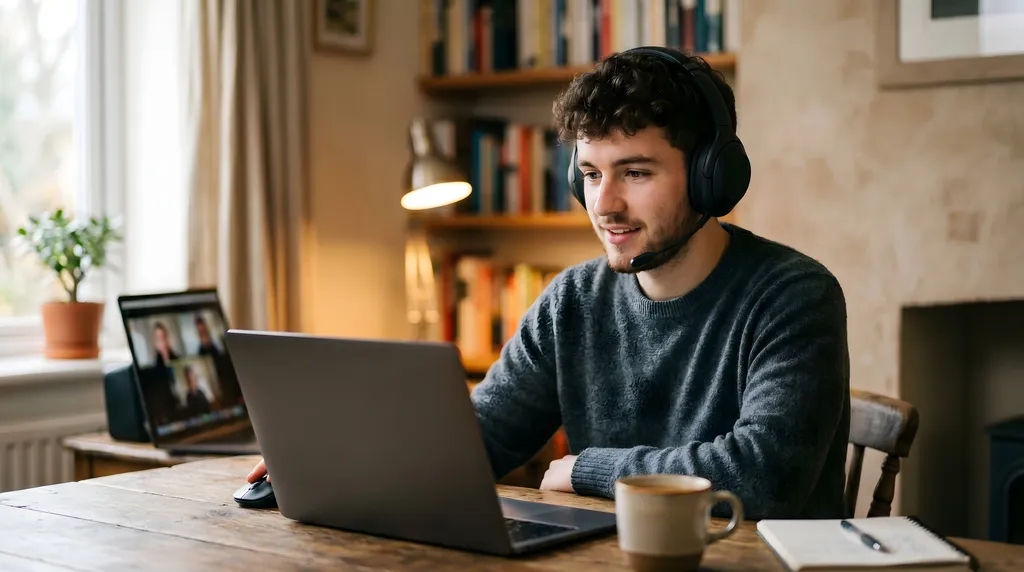

How an online autism assessment works
What information is gathered during an online autism assessment?
Start your assessment
The role of the ADOS-2 in online autism assessments
What is the ADOS-2?
The Autism Diagnostic Observation Schedule, Second Edition (ADOS-2) is an internationally recognised, gold-standard assessment tool used as part of autism diagnostic assessments worldwide.
It is a semi-structured observation and interview designed to assess:
- Social interaction
- Communication
- Patterns of behaviour
ADOS-2 modules
The ADOS-2 includes five modules, chosen based on age and language level:
- Toddler Module
- Module 1 (pre-verbal or single words)
- Module 2 (phrase speech)
- Module 3 (fluent speech with play-based tasks)
- Module 4 (fluent speech, adolescent and adult focused)
How the ADOS-2 can be completed fully online

Is an online ADOS-2 as valid as an in-person assessment?
Start your assessmentAdditional online assessment sessions

No clinic near you? Have your assessment at home
Prefer to be seen in person?
Is an online autism assessment right for you?
You may prefer an online assessment if
You may prefer an in-person assessment if
Arranging a fully online private autism assessment
Frequently asked questions
Will a private autism assessment be recognised?
Yes, it absolutely will, as long as it has been completed in a robust manner. There are many myths about a private autism assessment not being as good as NHS standards or that you can pay just to get a diagnosis. This is not the case. As long as you use a reputable company, such as us, you can be assured that your assessment, report and diagnostic outcome are robust and will be recognised by other services.
To be recognised, an assessment must:
- Meet NICE guidelines
- Be completed by appropriately registered clinicians (HCPC, NMC, etc.)
- Produce a comprehensive diagnostic report
You can read more about whether a private autism assessment will be recognised.
Will the NHS accept a private autism assessment?
The NHS accepts our autism assessments. National standards for autism assessments are laid out in the National Institute for Health and Care Excellence Guidelines (NICE Guidelines). The NHS requires that these guidelines be met. Our detailed reports evidence that the assessment has been completed to this standard and are therefore readily accepted by the NHS.
You can find out more here.
Do I need a GP referral?
No, you can refer yourself or your child for an autism assessment. We do not need a referral from your GP or your child’s school.
What if I am high-masking, will you still see autism?
Camouflaging and masking are strategies used by many autistic people to hide their differences. Our clinicians are specialists and observe the nuances of social communication and interactions during the assessment. Whilst autistic characteristics may not be obvious to untrained adults, our team will be able to recognise the signs.
You can find out more here.
Is masking a recognised part of adult autism?
Yes. Masking, sometimes called camouflaging, is widely described by autistic adults and is now well recognised in clinical research and practice. It involves consciously or unconsciously hiding autistic traits in order to fit in socially, for example by scripting conversations, copying other people’s mannerisms, or suppressing stimming.
Masking is one of the main reasons autism is harder to spot in women and in adults who have spent years adapting to a neurotypical world. It often comes at a cost: many people describe significant exhaustion, anxiety or burnout after long periods of masking.
Can a teenager have a fully online autism assessment?
Yes. Young people aged 10 and over with fluent language can have a fully online assessment using ADOS-2 Module 4. See online autism assessments for teenagers for how it works for families.
How much does an online autism assessment cost?
A fully online autism assessment costs £1,995. This includes the full assessment process, multi-disciplinary clinical review, a detailed written diagnostic report and a feedback session. See costs and waiting times.
Is an online autism test the same as an online assessment?
No. Online screening questionnaires such as the AQ-10 can suggest whether a full assessment is worth pursuing, but they cannot give a diagnosis. Our fully online assessment is a full clinical diagnostic assessment with a written report. If you are not sure yet, you can try our free AQ-10 screening test first.
Can I have an ADHD or combined autism and ADHD assessment online?
Yes. Both our ADHD assessment and our combined autism and ADHD assessment can be completed fully online for adults and young people aged 10 and over, in the same way as an autism assessment.
Children under 10 need to be seen in person. If our pre-screening suggests that a separate autism or ADHD assessment would suit you better, we will talk you through the options. You can read more about our combined autism and ADHD assessment for adults and for children, or see our costs and waiting times.