Introduction
Noticing differences in your two-year-old’s development can cause concern for parents. Many parents search for answers when their child communicates, plays, or responds to others in a different way.
This guide explains the early signs of autism in 2-year-olds, what is typical at this age, and when it may be helpful to seek further advice.
Autism in 2-year-olds
Autism is a neurodevelopmental difference that impacts how a child communicates and interacts with the worldaround them. Autism is present from birth, but often signs become more apparent as children grow. Every child is different; some children show clear traits of autism at the age of two, while for other children the signs at this age are much more subtle.
Typical development at the age of 2
All children develop differently, however, by the age of 2 the majority of children are:
- Using around 50 single words and beginning to use simple two-word phrases
- Showing interest in other children through watching them
- Enjoying simple pretend play
- Imitating your actions
- Using gestures such as pointing, waving and blowing kisses
- Responding to their name
Some children develop language a little later than others, and this does not necessarily mean that they are autistic. However, if the language delay occurs alongside other behaviours, such as not showing an interest in others, there may be something more going on.
What are the signs of autism in 2-Year-Olds?
Children on the autism spectrum show differences in social communication and interaction and also have restricted and repetitive interests and behaviours, which may include sensory differences. Let’s explore these characteristics further and consider the behaviours associated with them.
Language:
Many autistic 2-year-olds have delayed language development and/or limitations in their use of language.
This can include:
- Not using language, or only having a few words which are not used with meaning
- Language regression, developing some words at the expected time and then losing them
- Only using words or phrases that are copied from others or from television programmes or videos
- Using words that relate to a specific preoccupation, such as only saying the alphabet or counting
- Not using words to make requests, such as to ask for a drink
Non-verbal communication:
Neurotypical children tend to use non-verbal communication from an early age, and later to support their communication. Non-verbal communication includes gestures, facial expressions and eye contact. Autistic children tend to use less nonverbal communication.
You may notice that your 2-year-old does not:
- Use hand gestures, such as blowing kisses or waving goodbye
- Shake their head to mean ‘no’ or nod their head to mean ‘yes’
- Make eye contact or only makes fleeting eye contact
- Show how they are feeling through facial expressions
- Does not make silly faces, such as poking tongue out
- Point
Social interest:
Many autistic 2-year-olds do not appear to be interested in socially engaging with others, or may only want to engage on their own terms. Some children can appear as if they are in their own world, happily doing their own thing,regardless of those around them.
You may notice that your 2-year-old does not:
- Respond to their name when called
- Does not return your smile unless you are acting silly or tickling them
- Show interest in watching or engaging with other children, or may even become upset if other children are near them
- Engage in social games such as Row Your Boat or Tickle Monster with you
- Share things with you, such as showing you things that interest them
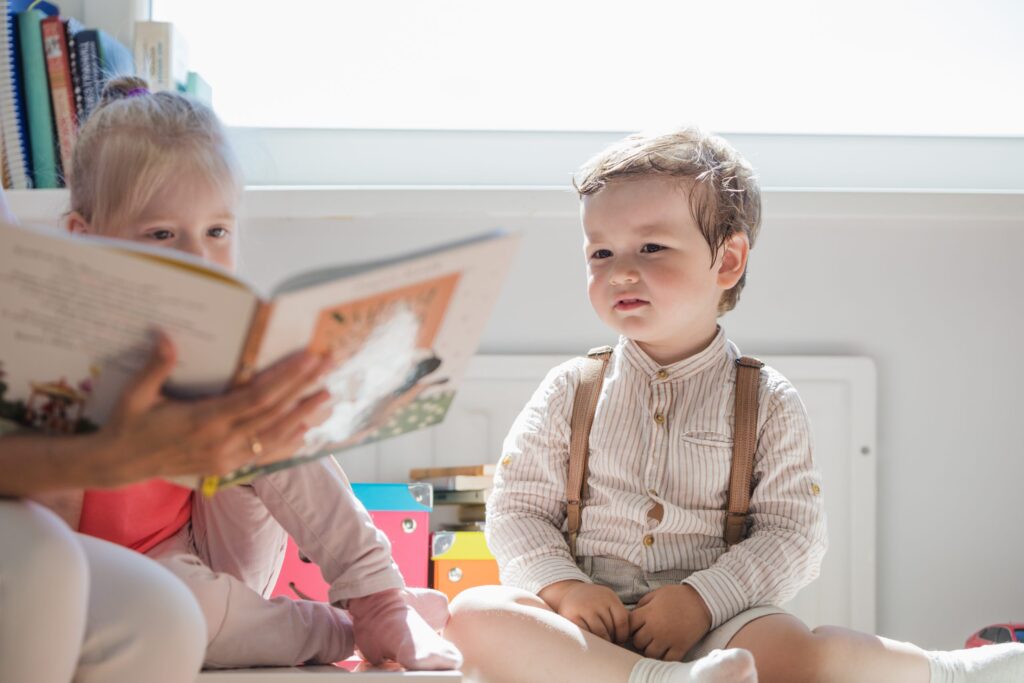
- Seem interested in shared activities such as looking at a book or doing a puzzle together
- Approach you to engage with you
Some autistic children will use an adult’s body to perform actions on their behalf. As if they are ‘a tool’.
You may notice that your child:
- Uses your hand to move objects, or push buttons rather than using their own
- Tries to open doors or gates with your hand
- Thrusts your hand towards things they want
- Tries to point with your hand
- Places their hands on your face to turn your head to look at something
Pretend play:
At age 2, neurotypical children engage in basic imaginative play. This might include feeding a doll, pretending to talk on a phone, serving tea or pretend food or driving a toy car into a garage for fuel. Autistic children often lack flexible, imaginative play, either not engaging in such play or only engaging in well-rehearsed play actions that have been previously demonstrated to them by someone else.
You may notice that your child:
- Does not show interest in playing with toys aimed at pretend play, such as dolls, toy kitchens, dress-up outfits or character toys
- Plays with toys designed for pretend play in a different way, for example, lining them up, or organising them
- Engages in some imaginative play, but does this in the same way each time, for example, placing a doll in a pram and pushing it
- Cannot ‘pretend’ an object is something else, such as pretending a toy block is a phone or a hairbrush is a microphone
Repetitive play and use of objects:
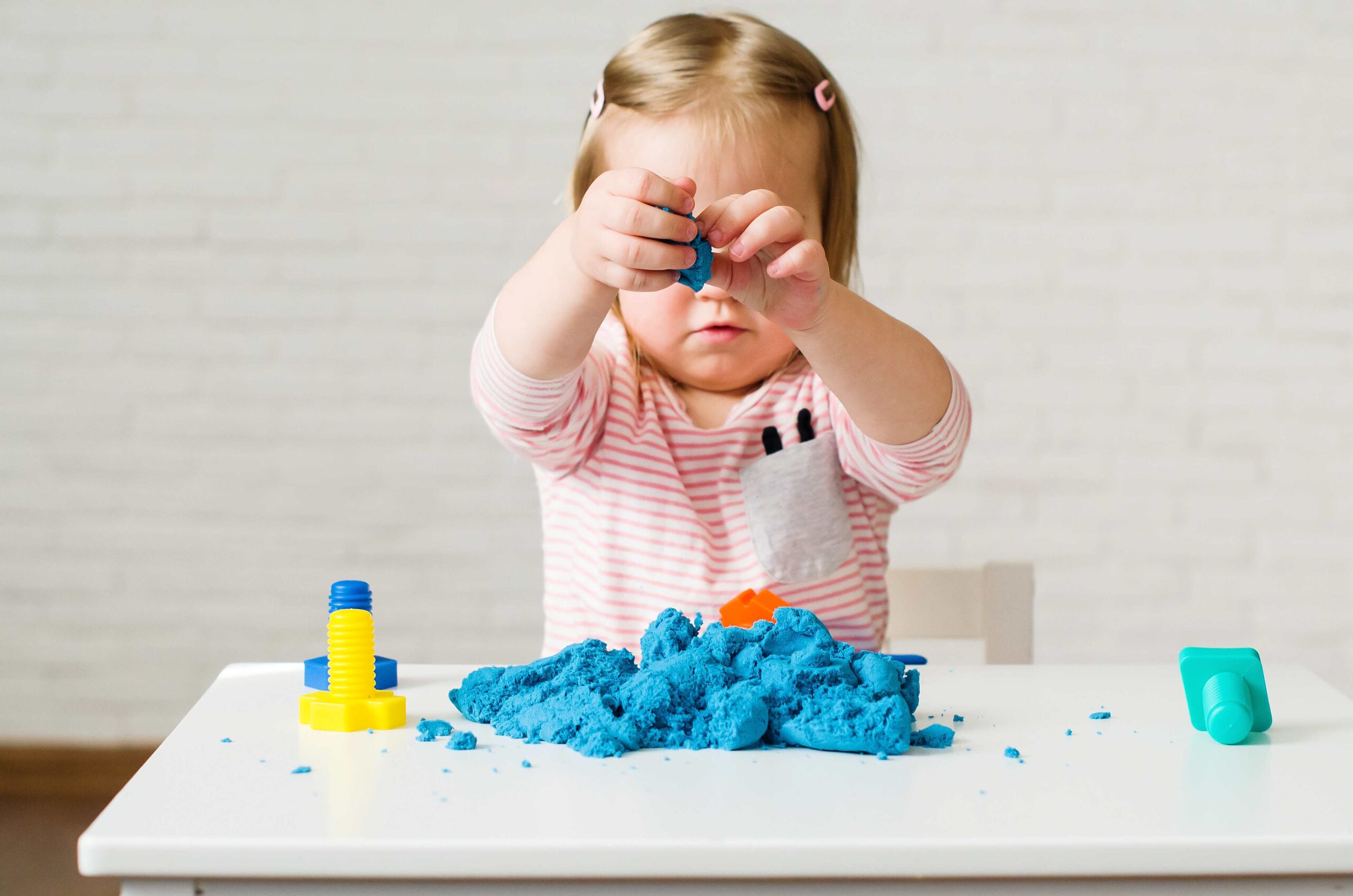
Many autistic 2-year-olds find pleasure in repetitive play, repeating the same actions with toys and objects during the day. You may sometimes notice them getting very excited or seeming very pleased with themselves when they have completed a sequence or have created something they enjoy observing.
You may notice behaviours such as:
- Making patterns with toys, such as lining up cars or teddies in rows
- Enjoying sorting and organising, emptying and refilling boxes, ordering numbers and letters
- Pushing buttons, opening and closing doors or flicking light switches on and off
- Stacking blocks and then knocking them over, and then repeating
- Appearing interested in part of a toy rather than the whole thing, for example, spinning wheels, opening and closing a doll’s eyes or car doors
- Watching the same programmes or videos over again
Repetitive Body Movements:
Often referred to as ‘stimming’, autistic children can often be observed to engage in repetitive body movements, which may be brief in duration or may go on for long periods. The behaviours might occur only when the child is stressed or excited, or they may occur consistently throughout the day.
Repetitive movements may involve the hands or the whole body, such as:
- Moving fingers in a repetitive way, tapping or flicking, for example
- Twirling, clenching or flapping hands
- Making repetitive noises or sounds
- Tapping or pinching their own or another’s body
- Jumping or bouncing
- Spinning self
- Posturing – holding body or parts of body in a tense way
Intense preoccupations:
Some autistic 2-year-olds can become preoccupied with objects, needing certain items with them at all times, wanting to collect items, or becoming excited when they see certain things.
Some autistic children will:
- Want to carry a specific number of objects in their hand (such as 3 straws or 2 cars) or have a specific number of objects near them at all times
- Want to collect unusual objects such as carrier bags, juice bottles or dust caps
- Appear preoccupied with specific items when out and about, such as wheels, wheelie bins or drain pipes
A need for routine and difficulties with changes:
Many autistic children find changes difficult and cope better with a familiar routine. However, sometimes these difficulties do not become apparent until the child is a little older.
Indicators of these issues in a 2-year-old include:
- Struggling to settle if there is a change to the usual routine, for example, if bathtime is missed
- Difficulties settling into pre-school
- Distress in new environments or around new people
- Upset if you take a different route on your journey
- Refusing to eat from different bowls and plates or drink from a different cup
- Unwilling to try new foods
- Refusal to acknowledge new toys
- Insistence on sitting in the same seat
Sensory differences:
Sensory differences are common for autistic children. A 2-year-old may be hyper-sensitive to sensory input, which can lead to distress or overwhelm and cause sensory-avoidant behaviours. They may be hypo-sensitive to sensory input, which can also cause dysregulation and leads to sensory seeking behaviours.
Hypersensitivity:
Indicators of hypersensitivity include:
- Difficulties with loud noises or busy places
- Dislike of certain fabrics or textures
- Dislikes wearing clothes or changing clothes or nappy
- Removing shoes and socks when outside
- Refusing to eat certain foods due to taste or texture, limited diet
- Distress at having hair washed, brushed or cut
- Resistance to having teeth brushed
- Not liking to have hands held or be hugged
Hyposensitivity:
Indicators of hyposensitivity include:
- Watching lights, shadows or light patterns
- Chewing clothes and other inedible objects
- Eating non-edible items such as sand, dirt, or fluff
- Licking or sniffing people or items in the environment
- Climbing excessively
- Jumping or bouncing off objects and furniture
- Constantly wanting to be swung or rocked
- Seeking deep pressure through hugs or wrapping self in blanket
Other common difficulties in autistic 2-year-olds
Although not technically signs of autism, it is common for 2-year-olds with autism spectrum disorder to also experience the following issues on a daily basis:
Sleep issues:
Difficulty settling to sleep, night waking or seemingly only needing a few hours of sleep to get by.
Difficulties regulating emotions:
Experiencing meltdowns which appear more frequent or more extreme than those of other 2-year-olds.
No sense of danger:
Needing constant supervision due to climbing and jumping off things, running off, placing non-edible objects in their mouths and/or not appearing to feel pain.
When to seek further advice
We have outlined many of the signs of autism above. Autism presents as a pattern of behaviours, and difficulties in one of the areas does not indicate that further screening is warranted.
However, if you are observing signs of autism in all of these areas:
- Language
- Non-verbal communication
- Social interest
And at least two of these areas:
- Repetitive play
- Repetitive movements
- Unusual preoccupations
- Difficulties with change
- Sensory differences
Then you should seek further advice about your 2-year-old’s needs.
Where to seek advice
If you are concerned that your child is showing signs of autism, you should talk to a professional about whether an autism assessment is warranted.
Before speaking to a professional, it might be worth making a list of all the behaviours that you are seeing to help you to remember them during the discussion.
Professionals who can refer children for an NHS autism assessment are usually:
- Staff at your child’s early years setting (if they attend one)
- Your Health Visitor
- Your child’s GP
But this will vary by area. Your local pathway may involve your child being reviewed by a paediatrician first.
A Reassuring Note for Parents
Seeking clarity about whether your child is autistic or not is the right thing to do. Many parents are made to feel blamed for wanting to ‘label’ their child. An autism diagnosis is not a label; it is a recognition of your child’s strengths and differences that helps to ensure they receive the correct support and understanding.
Early recognition of autism, along with the correct adjustments and support, leads to better long-term outcomes. Many parents feel that a diagnosis helps them better understand their child and can also open the door to autism support organisations and parent peer support.
Noticing and responding to early differences is a positive step towards understanding your child’s needs.
A note about autism assessment availability
Autism assessment pathways vary across local areas, as do their referral criteria. Some NHS autism pathways do not assess children at the age of 2, and you may be advised to wait until your child is older.
The majority of NHS autism pathway services have long waiting lists, with some areas reporting waiting times of over 5 years.
If you are unable to secure a referral to your local NHS pathway for your 2-year-old, or are facing long wait times, you may want to consider a Private Autism Assessment from a service such as ours, where your child will be seen in a matter of weeks rather than years.
Talk to us
If you are noticing signs of autism in your 2-year-old and are considering a private autism assessment, contact us to discuss your concerns. We will be more than happy to explain or process to you or to discuss whether we think an autism assessment is needed.