Opens in a new tab

Signs of Autism in Preschool Girls

The signs of autism in preschool girls are not always easy to recognise. During the preschool years, typically around 3 to 5 years old, differences may become more noticeable as children’s communication, imaginative play and interactions with other children develop. 

 Some autistic girls show clear developmental differences from an early age, while others talk fluently, enjoy imaginative play, show an interest in other children and appear to cope well at nursery. 

Parents may nevertheless notice differences in how their daughter communicates, plays, interacts with other children, responds to change or experiences sensory information. Sometimes these differences are much more noticeable at home than they are at nursery or preschool. 

In this article, Jo Condon, NMC Registered Mental Health Nurse, autism specialist and Clinical Lead of Jo Condon Autism Assessments, explores how autism can present in preschool girls, including some of the characteristics that can be overlooked when a young girl does not fit stereotypical ideas about autism. 
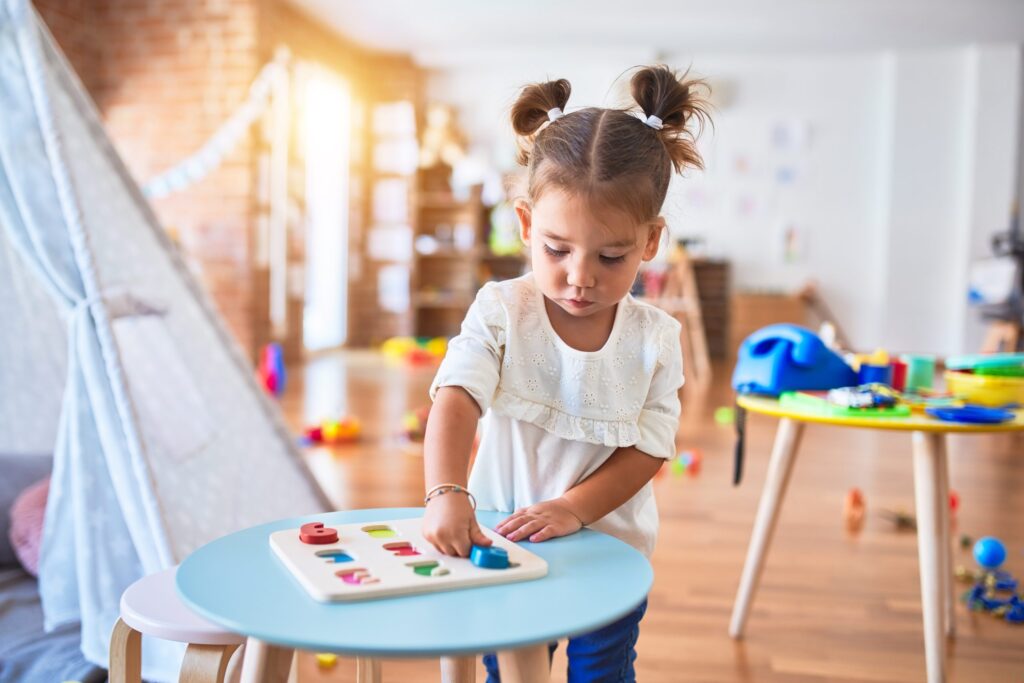
Young girl doing a puzzle at a small table in a playroom

What are the signs of autism in preschool girls? 

There is no separate set of autism diagnostic criteria for girls. Preschool autistic girls are also a very diverse group, so there is no single pattern that every preschool girl will follow. 

However, signs that parents or professionals might notice in younger girls include: 

Social interaction and shared play 

  • playing alongside other children rather than with them 
  • watching other children closely before joining their play 
  • wanting to play with other children but struggling with the unpredictability of shared play 
  • following other children’s ideas rather than adding her own 
  • directing play or expecting other children to follow particular rules 
  • withdrawing from play when it becomes difficult to understand or too unpredictable 

Communication 

  • using few spoken words or developing spoken language later  
  • repeating words, phrases or familiar lines heard elsewhere  
  • using familiar phrases in the same situations  
  • communicating readily to ask for something but less often simply to share an experience  
  • answering questions but offering less spontaneous information  
  • finding simple back-and-forth exchanges more difficult 

Non-verbal communication 

  • using eye contact differently or inconsistently during interaction  
  • pointing to request something but less often simply to share something interesting  
  • showing or bringing objects to another person less often simply to share interest or enjoyment  
  • using gestures such as waving or blowing kisses more readily after someone else has used them first  
  • facial expressions that do not always make it easy for other people to understand how she is responding 

Repetitive behaviour 

  • arranging, sorting or categorising objects 
  • repeatedly using parts of toys in the same way 
  • returning to the same actions or sequences 
  • repetitive movements, sounds or sensory behaviours 

Play and interests 

  • repeatedly recreating familiar stories, scenes or play sequences 
  • preferring familiar play themes and activities 
  • developing particularly strong or focused interests 
  • becoming very absorbed in particular toys, characters, objects or themes 

Routine, predictability and transitions 

  • wanting familiar activities to happen in the same way or order  
  • becoming upset when an expected person, activity or routine changes  
  • finding it difficult to stop a preferred activity  
  • finding transitions between activities difficult  
  • having strong preferences for familiar foods, objects, places or routes  
  • coping better when changes and transitions are prepared for in advance 

Sensory differences 

  • becoming overwhelmed by loud or sudden noises, such as hand dryers, vacuum cleaners or busy nursery environments 
  • disliking particular clothing, seams, labels or certain fabrics 
  • finding hair brushing, hair washing, tooth brushing or nail cutting particularly difficult 
  • having strong preferences around food textures, smells or presentation 
  • avoiding messy play, particular textures or physical touch 
  • seeking movement through spinning, jumping, climbing or rocking 
  • chewing clothing, toys or other objects 
  • repeatedly touching, rubbing, smelling or looking closely at particular objects 

None of these characteristics on its own means that a preschool child is autistic. Clinicians consider the overall developmental pattern, including communication, social interaction, play, repetitive behaviours, interests, flexibility and sensory experiences across different situations and over time. 

Not all autistic preschool girls have a subtle presentation. Much of the discussion about autism in girls focuses on girls whose characteristics are less immediately apparent. Some autistic girls show very clear developmental differences from early childhood. They may use few or no spoken words, show more noticeable repetitive behaviours, have significant sensory differences or need considerable support with everyday activities. Some autistic girls also have a learning disability or other developmental differences. 

Other girls are verbally fluent and socially interested, and their autistic characteristics can be more difficult to recognise. 

There is therefore no single “female presentation” of autism.  

What can the signs of autism in preschool girls look like?

Speech and social communication 

Autistic preschool girls vary considerably in their language development. Some use few or no spoken words, some develop spoken language later, while others develop speech within expected timeframes and may have an extensive vocabulary. Where speech is fluent, differences may be more noticeable in how language is used socially rather than in how much a child can say. 

For example, a girl might confidently name objects, answer questions or talk about something she enjoys, but be less likely to spontaneously tell another person about something that has happened or comment simply because she wants to share an experience. She may repeat familiar words or phrases from books, programmes or other people, or use particular phrases in the same situations each time. Back-and-forth exchanges may be harder to sustain, and she may communicate more readily to request something, get help or direct what happens than simply to share interest or enjoyment with another person. 

The important distinction is therefore not simply how well or how much a preschool child talks, but how speech and language are used to communicate socially, share experiences and involve other people. 

Pointing, showing and sharing attention 

An important part of early social communication is joint attention, which describes the way a young child shares attention, interest or enjoyment with another person. 

For example, a child might point because she wants something, such as a toy or snack.  

Sharing attention is slightly different. She might notice an aeroplane in the sky, point towards it and then look back at her parent to make sure they have seen it too. Similarly, she might bring an adult a favourite toy, not because she needs help with it, but simply because she wants to show it to them and share her enjoyment. 

Some autistic preschool girls may use pointing effectively when requesting something but do so less often simply to share an interesting experience. They may bring an adult an object when they need help but be less likely to bring something over purely to show it. A child might also become absorbed in something interesting without naturally looking back towards another person to draw them into the experience, or find it more difficult to follow another person’s point or gaze. 

These differences can be subtle and vary considerably between children. Joint attention is therefore considered as part of the wider pattern of a child’s social communication and development, rather than being treated as a standalone sign of autism. 

Eye contact

A common misconception is that autistic children do not make eye contact. Many autistic preschool girls do make eye contact, so the presence of eye contact does not rule out autism. 

What can be particularly interesting in some young girls is how they use gaze. A girl may watch an adult’s face very closely, particularly when she is unsure about a situation or trying to work out what is expected of her. For example, she might look towards a parent’s or nursery practitioner’s face before responding, almost as though she is checking their reaction for information about what she should do next. From the outside, this close “face watching” can sometimes be interpreted simply as good eye contact. 

Clinicians therefore consider much more than whether a child looks at another person’s face. They look at how naturally and spontaneously gaze is used and how it works alongside speech, facial expressions, gestures and shared attention. A child may also use gaze differently depending on who she is with, how familiar the situation is and whether she is uncertain about what is happening. 

The important question is not simply “Does she make eye contact?”, but how she uses gaze as part of her wider social communication. 

Facial expressions and gestures 

Non-verbal communication includes the facial expressions and gestures we use to share meaning with other people. 

In some autistic preschool girls, differences in non-verbal communication can be quite subtle. A child may use gestures, but they may be less spontaneous or not always naturally coordinated with what she is saying. Facial expressions may sometimes appear limited, exaggerated or not quite matched to the interaction. 

Other girls may watch people closely and begin to notice how particular expressions or gestures are received. For example, some young girls may use smiling very readily in social situations. They may have learned through experience that smiling often produces a warm, positive response from adults, even when they are uncertain about what is expected of them. From the outside, this can contribute to an impression that their non-verbal social communication is entirely intuitive. 

This does not mean that smiling is simply copied or that an autistic child’s expressions are not genuine. Rather, it highlights why clinicians consider how facial expression, gesture, eye contact and spoken communication work together across different situations, rather than judging social communication on whether a child smiles, looks at someone or uses a particular gesture. 

Playing and interacting with other children 

Some autistic preschool girls are noticeably interested in other children. They may approach peers, join games, talk about friends and become excited when familiar children arrive at nursery. This can sometimes make social differences less obvious, because wanting to interact with other children is not the same as finding the back-and-forth of social interaction easy to navigate. 

During the preschool years, children increasingly move from playing alongside one another towards more shared and cooperative play. Playing together requires children to do much more than simply occupy the same activity. They need to notice and respond to what another child is doing, communicate their own ideas, take turns, negotiate differences and continually adjust as the interaction develops. 

Some autistic girls may manage particularly well when there is an obvious structure to the interaction. Completing a puzzle together, taking turns on a slide or playing a familiar chasing game can be easier because what happens next is relatively predictable. Free-flowing shared play can be much harder because another child can suddenly change the activity, introduce a new idea or expect a response that was not anticipated. 

This can result in quite different social styles. One girl may appear quiet or passive within a group, watching the other children closely and using their behaviour as a guide for what to do next. She may successfully remain part of the activity while relying heavily on other children to provide the ideas and direction. From the outside, this can look like confident participation because she is physically joining in and following the group. 

Another girl, or the same girl in a different situation, may appear confident and take the lead. She might be very good at bringing children together and organising an activity, but find interaction easier when she provides the structure. She may decide who does what, establish the rules or explain how the game should unfold. Difficulties may become more apparent when another child wants to negotiate, has a different idea or does not respond in the way she expected. 

These patterns should not be interpreted as a child being simply “passive”, “bossy” or “controlling”. Following other children and directing them can both make an unpredictable social situation more manageable. 

Clinicians therefore look beyond whether a preschool child likes other children, has friends or joins group play. They consider how she manages the reciprocity of shared interaction: whether she can initiate and respond, contribute ideas as well as follow them, take account of another child’s ideas, negotiate differences, repair misunderstandings and remain socially engaged when there is no clear script for what should happen next. 

Importantly, autistic girls can form genuine, affectionate and enjoyable relationships with other children. The difference is not necessarily in the desire for social connection, but in how intuitively and flexibly the child manages the constantly changing demands of interaction. 
How play develops: pretend and imaginative play 

Social play tells us something about how a child interacts with other people. Looking at the development of play itself can tell us something different. 

During the preschool years, play typically becomes increasingly symbolic and elaborate. Early pretend actions, such as feeding a doll, pretending to drink from an empty cup or using one object to represent another, gradually develop into longer sequences involving characters, stories and imaginary situations. 

Many autistic preschool girls also engage in pretend and imaginative play. A girl may love dolls, dressing up, animals, role play, small-world toys or elaborate fictional worlds. The presence of imagination therefore does not rule out autism. 

What may sometimes be different is the quality and development of the play. 

A girl may have a rich imagination but repeatedly return to familiar scenarios. She might recreate something she has seen on television, read in a book or experienced in everyday life, sometimes in considerable detail. Other girls may generate their own elaborate worlds and characters. 

When looking at development, clinicians are therefore interested in more than whether a child can make a doll drink from a cup or pretend that a cardboard box is a house. They consider whether her play expands over time, whether she generates new ideas, whether different toys and experiences can be incorporated and how spontaneously she develops new themes. 

Shared imaginative play adds another layer because another person’s imagination becomes involved. A child may have sophisticated imaginative play independently but find it harder when somebody else’s idea changes what she had expected to happen. 

This does not make her play less imaginative. It simply means that imagination and flexibility are different things. 

There is also considerable variation in typical preschool development. Parallel play, repetitive favourite games and wanting to direct an activity can all occur in non-autistic young children. It is therefore helpful to consider quality of play alongside the child’s wider social communication, flexibility and developmental history. 

Focused interests 

Like other autistic children, some preschool girls develop particularly strong interests. The subject itself may appear completely ordinary for their age, such as animals, a television character, dolls, numbers, letters or a particular story. 

What may stand out is the intensity of the interest rather than its subject. A child may want to return to it repeatedly, talk about it frequently, incorporate it into much of her play or notice details that other children overlook. 

Focused interests can be an important source of enjoyment, knowledge and connection.

Repetitive play and behaviour 

Repetition is another aspect of play that can be particularly important to understand. 

Young children naturally repeat enjoyable activities. A preschool child wanting the same story several nights in a row or playing a favourite game repeatedly is not unusual. In autistic children, however, repetitive patterns may sometimes be more frequent, intense, persistent or important to the child’s experience. 

For example, a girl may repeatedly arrange toys in a particular order, sort objects according to colour or type, spin the wheels of a toy vehicle or perform the same action with an object many times. She may be more interested in creating or setting up scenes than playing with the toys afterwards. She may return repeatedly to particular sequences within play or become especially interested in particular parts or sensory features of a toy. 

Repetitive behaviour is not limited to toys. Some preschool girls may flap their hands, rock, spin, pace, jump repeatedly, make repeated sounds or seek particular visual, tactile or movement experiences. These behaviours may be very noticeable in some autistic girls and much less obvious in others. 

It is important not to assume that repetition has no purpose or that it must automatically be stopped. Repetition may be enjoyable, regulating, sensory, reassuring or simply an important way in which a child explores and engages with the world. 

We explore this in more detail in our guide to repetitive play in autistic children. 

Sensory differences 

Autistic preschool girls may experience sensory information differently from other children. Everyday sensory experiences can feel particularly intense or uncomfortable. A busy nursery, for example, can bring together competing voices, sudden noises, bright lighting, physical contact and lots of movement. At home, sensory differences might be more apparent around clothing and seams, particular food textures or smells, hair brushing, washing or being touched unexpectedly. 

Sensory differences do not always involve avoiding sensations. Some children actively seek sensory experiences and may enjoy spinning, jumping, climbing, chewing objects, touching particular textures, making repetitive sounds or watching things move. A child can also be sensory seeking in one area and highly sensitive in another. For example, she might love vigorous movement but find the noise of a hand dryer overwhelming, or enjoy messy play while being extremely particular about the texture of her clothing. 

Sensory demands can also build up across the day. Nursery involves far more than one noise or sensation at a time. A child may be simultaneously managing other children, movement, smells, transitions, messy play, noise and the social demands of the environment. This can help explain why she appears to manage individual sensory experiences but becomes increasingly overwhelmed or exhausted as the day progresses. 

We explore this further in our guide to Sensory differences in autistic preschool children.

Routine, predictability and transitions 

Young autistic children may rely on familiarity and predictability to make everyday life easier to understand. In a preschool girl, this can appear in very ordinary parts of the day. She may expect to use the same cup, want particular foods presented in the same way, follow the same bedtime sequence or become attached to familiar routes, places, toys or activities. 

The difficulty may become more noticeable when something does not happen as expected. The usual chair might be occupied, a favourite toy may not be available, nursery might change the order of activities, or a familiar adult may be absent. A young child may not be able to explain why this feels difficult and may instead cry, resist, become upset or try repeatedly to restore the familiar routine. 

Transitions can be particularly important at this age. Moving away from a preferred activity, putting toys away, getting dressed to leave the house, changing from free play to snack time or moving from the playground back indoors may be difficult even when the child understands what is happening. Some children need considerably more adult prompting, preparation or time than their peers to move from one activity to another. 

Predictability can help. Simple countdowns, visual cues, familiar routines and clear signals that an activity is about to finish may make transitions easier. A child may also cope better when an adult shows rather than verbally explains what is happening next. 

Importantly, eventually completing a transition does not necessarily mean that it was easy. It can be useful to consider how much adult support was needed, how distressed the child became and how quickly she was able to settle into the next activity. 

Why might she seem different at home and nursery? 

Parents sometimes describe a striking difference between the child they see at home and the child nursery staff describe. At nursery, a young autistic girl may appear settled, cooperative and keen to join in, while at home parents see much more rigidity, repetitive behaviour, sensory distress or emotional overwhelm. 

Some girls become very focused on doing what is expected of them. They may watch other children to work out what they are supposed to do, follow familiar nursery routines closely and respond well to clear rules such as sitting in a particular place, lining up with everyone else or tidying away when the group is told to. A child who wants to fit in may also follow what other children are doing even when she is unsure or uncomfortable. From the outside, this can make her appear to be coping very well. 

Nursery itself may provide helpful structure. The day often follows a familiar pattern, adults give prompts and children can use their peers as a guide. A girl may therefore successfully take part without adults necessarily recognising how much she relies on that structure, modelling and predictability. 

Home can be very different. A child may be more relaxed in familiar surroundings and no longer have the same need to watch other children, follow the group or work out what is expected of her. Parents may therefore see behaviours that are less apparent at nursery, including repetitive play, stronger sensory preferences, insistence on familiar routines or a greater need to control what happens around her. The accumulated demands of the nursery day may also become more apparent once she gets home, through tiredness, withdrawal, irritability or emotional overwhelm. 

This does not mean that the child is deliberately behaving differently at nursery and home, or that one account is more accurate than the other. Both environments provide important information about how she manages different demands. A child appearing settled at nursery should therefore be considered alongside what parents observe before nursery, afterwards and at home. 

For some children, the cumulative impact of the nursery day only becomes apparent afterwards. Parents may notice crying, irritability, withdrawal, a greater need for familiar routines, difficulty tolerating everyday demands or simply a need for considerable quiet time. 

There may be several things contributing at once, including sensory input, transitions, communication demands, uncertainty, social interaction and ordinary tiredness. This does not necessarily mean that a child has been deliberately “masking” all day. Rather, the effort involved in navigating a demanding environment may only become visible once the nursery session has ended. 

Why can autism be missed in preschool girls? 

Sometimes parents have had a sense for quite a while that their daughter experiences the world differently, even when other people have not noticed the same things. 

This can be particularly confusing when a child is talkative, imaginative, affectionate and interested in other children. She may make eye contact, join in at nursery and even appear particularly sociable. These things do not rule out autism. Sometimes the differences become clearer only when we look more closely at how she communicates and shares attention, how she manages shared play, how she responds to changes and what parents observe in different environments. 

Individual behaviours can also be easily explained away. A girl may be described as shy because she watches before joining in, bossy because she tries to control a game, sensitive because she struggles with noise or clothing, or simply very well behaved because she carefully follows the rules at nursery. 

None of those descriptions is necessarily wrong. The important thing is to step back and look at the whole child rather than each behaviour in isolation. 

Some autistic preschool girls have very noticeable developmental differences, while others have a presentation that is much easier to overlook. There is no single way an autistic girl should look or behave. 

We explore why this happens in more detail in our guide to the signs of autism in girls. 

When should parents seek advice? 

There is no single sign or behaviour that can tell a parent whether their preschool child is autistic. 

What matters is whether there appears to be a consistent pattern of developmental differences involving areas such as social communication, interaction, play, flexibility, repetitive behaviour and sensory experiences. 

If you have ongoing concerns, you can discuss them with your child’s health visitor, GP, nursery or other professionals involved in their care. 

It can help to give concrete examples rather than simply saying that something feels different.  

For example: 

  • what happens when another child tries to change your daughter’s game 
  • how she asks for or shares things with you 
  • what happens when plans change 
  • sensory experiences she finds particularly difficult 
  • repetitive behaviours or play patterns you have noticed 
  • differences between home and nursery. 

Information from different settings can help build a much fuller picture of your child’s development. 

What if I’m unsure whether an autism assessment is needed? 

It is understandable to be uncertain, particularly when some aspects of your daughter’s development seem typical while others concern you. 

Recognising several characteristics in this article does not automatically mean that a child is autistic. Autism assessment considers the overall developmental picture, rather than relying on a checklist or a single behaviour. 

At Jo Condon Autism Assessments, we offer free autism screening for parents who are unsure whether a full autism assessment is an appropriate next step. We know that deciding whether to pursue a private autism assessment is a big step, particularly when your child is still very young. Our free autism screening gives families somewhere to start, so we can consider the concerns you have and whether a full assessment appears to be an appropriate next step. 

Final thoughts

There isn’t one way for autism to look in a preschool girl. 

Some autistic girls show clear developmental differences from a very young age. Others talk fluently, seek relationships, make eye contact and engage in imaginative play, while experiencing less obvious differences in social communication, shared attention, flexibility or sensory processing. 

Recognising autism in a young girl therefore means looking beyond individual behaviours and considering how the different parts of her development fit together over time and across different situations. 

For parents who have felt for some time that something is different, this wider perspective can help make sense of what they are seeing and provide a clearer idea of what support their daughter might need. 

FAQ

What are the signs of autism in a 2-year-old girl? 

At two, signs of autism may be seen in early communication, shared attention, gestures, play and responses to the world around her. An autistic 2-year-old girl might use few spoken words or develop language later, although some autistic girls are already using plenty of words at this age. 

Parents might notice differences in how their daughter uses communication socially. For example, she may point or take an adult to something she wants but be less likely to point simply to show something interesting. She may bring an adult an object when she needs help but less often simply to share her interest or enjoyment. 

Differences may also be seen in play, such as repetitive use of toys, strong preferences for particular activities or becoming absorbed in certain objects. Sensory differences, repetitive movements and distress when familiar routines change may also be noticeable. 

For a broader look at this developmental stage, see our Signs of Autism in 2-Year-Olds guide. 

What are the signs of autism in a 3-year-old girl? 

At three, differences may become more noticeable as language, shared attention, pretend play and interaction with other children develop. An autistic 3-year-old girl might use few spoken words, repeat familiar phrases or be very talkative but use language differently during social interaction. 

She may be interested in other children but find shared play more difficult, perhaps watching and following other children, playing alongside them or preferring familiar play sequences. Sensory differences, repetitive behaviours and difficulties moving between activities may also become more apparent. 

Some autistic 3-year-old girls make eye contact, enjoy imaginative play and actively seek interaction with other children. None of these things rules out autism. 

For a broader look at development at this age, see our Signs of Autism in 3-Year-Olds guide. 

What are the signs of autism in a 4-year-old girl? 

At four, play and relationships with other children may be becoming increasingly complex. An autistic girl may be keen to join other children but find the unpredictability of shared play more difficult. She might follow another child’s ideas, watch and copy what other children are doing, or prefer to organise the activity herself so that she knows how the game will unfold. 

Differences may also be seen in social communication, imaginative or repetitive play, focused interests, sensory experiences and responses to transitions or unexpected changes. Some girls appear to manage very well at nursery, particularly when routines are predictable, and they can follow other children, while parents notice a much greater need for familiarity or more overwhelm at home. 

For a broader look at development at age 4, see our Signs of Autism in 4-Year-Olds guide. 

References 

American Psychiatric Association (2022) Diagnostic and Statistical Manual of Mental Disorders, Fifth Edition, Text Revision (DSM-5-TR). Washington, DC: American Psychiatric Association Publishing.  

Chellew, T., Barbaro, J. and Freeman, N.C. (2024) ‘The early childhood signs of autism in females: a systematic review’, Review Journal of Autism and Developmental Disorders, 11, pp. 249–264. https://doi.org/10.1007/s40489-022-00337-3.  

Dean, M., Harwood, R. and Kasari, C. (2017) ‘The art of camouflage: Gender differences in the social behaviors of girls and boys with autism spectrum disorder’, Autism, 21(6), pp. 678–689.  

Lockwood Estrin, G., Milner, V., Spain, D., Happé, F. and Colvert, E. (2021) ‘Barriers to autism spectrum disorder diagnosis for young women and girls: a systematic review’, Review Journal of Autism and Developmental Disorders, 8(4), pp. 454–470. https://doi.org/10.1007/s40489-020-00225-8.  

National Institute for Health and Care Excellence (NICE) (2017) Autism spectrum disorder in under 19s: recognition, referral and diagnosis (CG128). London: NICE. Originally published 2011; last updated 20 December 2017.  

Wiggins, L.D., Rubenstein, E., Windham, G., Barger, B., Croen, L., Dowling, N., Giarelli, E., Levy, S., Moody, E., Soke, G., Fields, V. and Schieve, L. (2021) ‘Evaluation of sex differences in preschool children with and without autism spectrum disorder enrolled in the Study to Explore Early Development’, Research in Developmental Disabilities, 112, 103897. https://doi.org/10.1016/j.ridd.2021.103897.  

Last reviewed: November 2026

How we can help

If you have concerns about your child’s development, communication or behaviour, a private autism assessment can help you understand their needs. Jo Condon Autism Assessments provides NICE-compliant autism assessments for children from the age of two, carried out by experienced clinicians. Children under 10 are seen in person at one of our clinics. If you are not yet sure whether an assessment is right for your child, our free online screening test is a good place to start.


Portrait of Jo Condon, founder, clinical lead and director

Jo Condon

Founder, Director and Clinical Lead
Jo Condon is an NMC Registered Mental Health Nurse, autism specialist and Founder and Clinical Lead of Jo Condon Autism Assessments. With more than 25 years of experience across CAMHS, autism and ADHD services, national autism strategy, SEND and diagnostic assessment, she is a former National Autism Lead for Wales and co-author of peer-reviewed autism research published in Molecular Autism. Jo writes about autism, assessment and neurodivergence across the lifespan, with particular interests in the early identification of autism in younger children and in complex, less obvious and later-recognised presentations of autism in children and adults.

More posts

Father and son laughing together on a sofa

Signs of autism in teenage boys

Many parents first become concerned about autism when their son reaches adolescence. Although autism is a lifelong neurodevelopmental difference present from early childhood, the teenage…
Learn more
Toddler lining up toy cars on a sofa

How early can autism be diagnosed? A parent’s guide to early autism assessment

Autism can sometimes be diagnosed from around 18 months of age, although many children are diagnosed later. Reliable autism assessments can often be completed from…
Learn more
Young girl in a yellow top covering her face with her hands

Emotional dysregulation in autistic children: signs, causes and how to help

Emotional dysregulation is one of the most common yet misunderstood experiences for autistic children and young people. Although it is not part of the formal…
Learn more

The signs of autism in preschool girls are not always easy to recognise. During the preschool years, typically around 3 to 5 years old, differences may become more noticeable as children’s communication, imaginative play and interactions with other children develop. 

 Some autistic girls show clear developmental differences from an early age, while others talk fluently, enjoy imaginative play, show an interest in other children and appear to cope well at nursery. 

Parents may nevertheless notice differences in how their daughter communicates, plays, interacts with other children, responds to change or experiences sensory information. Sometimes these differences are much more noticeable at home than they are at nursery or preschool. 

In this article, Jo Condon, NMC Registered Mental Health Nurse, autism specialist and Clinical Lead of Jo Condon Autism Assessments, explores how autism can present in preschool girls, including some of the characteristics that can be overlooked when a young girl does not fit stereotypical ideas about autism. 

Young girl doing a puzzle at a small table in a playroom

What are the signs of autism in preschool girls? 

There is no separate set of autism diagnostic criteria for girls. Preschool autistic girls are also a very diverse group, so there is no single pattern that every preschool girl will follow. 

However, signs that parents or professionals might notice in younger girls include: 

Social interaction and shared play 

  • playing alongside other children rather than with them 
  • watching other children closely before joining their play 
  • wanting to play with other children but struggling with the unpredictability of shared play 
  • following other children’s ideas rather than adding her own 
  • directing play or expecting other children to follow particular rules 
  • withdrawing from play when it becomes difficult to understand or too unpredictable 

Communication 

  • using few spoken words or developing spoken language later  
  • repeating words, phrases or familiar lines heard elsewhere  
  • using familiar phrases in the same situations  
  • communicating readily to ask for something but less often simply to share an experience  
  • answering questions but offering less spontaneous information  
  • finding simple back-and-forth exchanges more difficult 

Non-verbal communication 

  • using eye contact differently or inconsistently during interaction  
  • pointing to request something but less often simply to share something interesting  
  • showing or bringing objects to another person less often simply to share interest or enjoyment  
  • using gestures such as waving or blowing kisses more readily after someone else has used them first  
  • facial expressions that do not always make it easy for other people to understand how she is responding 

Repetitive behaviour 

  • arranging, sorting or categorising objects 
  • repeatedly using parts of toys in the same way 
  • returning to the same actions or sequences 
  • repetitive movements, sounds or sensory behaviours 

Play and interests 

  • repeatedly recreating familiar stories, scenes or play sequences 
  • preferring familiar play themes and activities 
  • developing particularly strong or focused interests 
  • becoming very absorbed in particular toys, characters, objects or themes 

Routine, predictability and transitions 

  • wanting familiar activities to happen in the same way or order  
  • becoming upset when an expected person, activity or routine changes  
  • finding it difficult to stop a preferred activity  
  • finding transitions between activities difficult  
  • having strong preferences for familiar foods, objects, places or routes  
  • coping better when changes and transitions are prepared for in advance 

Sensory differences 

  • becoming overwhelmed by loud or sudden noises, such as hand dryers, vacuum cleaners or busy nursery environments 
  • disliking particular clothing, seams, labels or certain fabrics 
  • finding hair brushing, hair washing, tooth brushing or nail cutting particularly difficult 
  • having strong preferences around food textures, smells or presentation 
  • avoiding messy play, particular textures or physical touch 
  • seeking movement through spinning, jumping, climbing or rocking 
  • chewing clothing, toys or other objects 
  • repeatedly touching, rubbing, smelling or looking closely at particular objects 

None of these characteristics on its own means that a preschool child is autistic. Clinicians consider the overall developmental pattern, including communication, social interaction, play, repetitive behaviours, interests, flexibility and sensory experiences across different situations and over time. 

Not all autistic preschool girls have a subtle presentation. Much of the discussion about autism in girls focuses on girls whose characteristics are less immediately apparent. Some autistic girls show very clear developmental differences from early childhood. They may use few or no spoken words, show more noticeable repetitive behaviours, have significant sensory differences or need considerable support with everyday activities. Some autistic girls also have a learning disability or other developmental differences. 

Other girls are verbally fluent and socially interested, and their autistic characteristics can be more difficult to recognise. 

There is therefore no single “female presentation” of autism.  

What can the signs of autism in preschool girls look like?

Speech and social communication 

Autistic preschool girls vary considerably in their language development. Some use few or no spoken words, some develop spoken language later, while others develop speech within expected timeframes and may have an extensive vocabulary. Where speech is fluent, differences may be more noticeable in how language is used socially rather than in how much a child can say. 

For example, a girl might confidently name objects, answer questions or talk about something she enjoys, but be less likely to spontaneously tell another person about something that has happened or comment simply because she wants to share an experience. She may repeat familiar words or phrases from books, programmes or other people, or use particular phrases in the same situations each time. Back-and-forth exchanges may be harder to sustain, and she may communicate more readily to request something, get help or direct what happens than simply to share interest or enjoyment with another person. 

The important distinction is therefore not simply how well or how much a preschool child talks, but how speech and language are used to communicate socially, share experiences and involve other people. 

Pointing, showing and sharing attention 

An important part of early social communication is joint attention, which describes the way a young child shares attention, interest or enjoyment with another person. 

For example, a child might point because she wants something, such as a toy or snack.  

Sharing attention is slightly different. She might notice an aeroplane in the sky, point towards it and then look back at her parent to make sure they have seen it too. Similarly, she might bring an adult a favourite toy, not because she needs help with it, but simply because she wants to show it to them and share her enjoyment. 

Some autistic preschool girls may use pointing effectively when requesting something but do so less often simply to share an interesting experience. They may bring an adult an object when they need help but be less likely to bring something over purely to show it. A child might also become absorbed in something interesting without naturally looking back towards another person to draw them into the experience, or find it more difficult to follow another person’s point or gaze. 

These differences can be subtle and vary considerably between children. Joint attention is therefore considered as part of the wider pattern of a child’s social communication and development, rather than being treated as a standalone sign of autism. 

Eye contact

A common misconception is that autistic children do not make eye contact. Many autistic preschool girls do make eye contact, so the presence of eye contact does not rule out autism. 

What can be particularly interesting in some young girls is how they use gaze. A girl may watch an adult’s face very closely, particularly when she is unsure about a situation or trying to work out what is expected of her. For example, she might look towards a parent’s or nursery practitioner’s face before responding, almost as though she is checking their reaction for information about what she should do next. From the outside, this close “face watching” can sometimes be interpreted simply as good eye contact. 

Clinicians therefore consider much more than whether a child looks at another person’s face. They look at how naturally and spontaneously gaze is used and how it works alongside speech, facial expressions, gestures and shared attention. A child may also use gaze differently depending on who she is with, how familiar the situation is and whether she is uncertain about what is happening. 

The important question is not simply “Does she make eye contact?”, but how she uses gaze as part of her wider social communication. 

Facial expressions and gestures 

Non-verbal communication includes the facial expressions and gestures we use to share meaning with other people. 

In some autistic preschool girls, differences in non-verbal communication can be quite subtle. A child may use gestures, but they may be less spontaneous or not always naturally coordinated with what she is saying. Facial expressions may sometimes appear limited, exaggerated or not quite matched to the interaction. 

Other girls may watch people closely and begin to notice how particular expressions or gestures are received. For example, some young girls may use smiling very readily in social situations. They may have learned through experience that smiling often produces a warm, positive response from adults, even when they are uncertain about what is expected of them. From the outside, this can contribute to an impression that their non-verbal social communication is entirely intuitive. 

This does not mean that smiling is simply copied or that an autistic child’s expressions are not genuine. Rather, it highlights why clinicians consider how facial expression, gesture, eye contact and spoken communication work together across different situations, rather than judging social communication on whether a child smiles, looks at someone or uses a particular gesture. 

Playing and interacting with other children 

Some autistic preschool girls are noticeably interested in other children. They may approach peers, join games, talk about friends and become excited when familiar children arrive at nursery. This can sometimes make social differences less obvious, because wanting to interact with other children is not the same as finding the back-and-forth of social interaction easy to navigate. 

During the preschool years, children increasingly move from playing alongside one another towards more shared and cooperative play. Playing together requires children to do much more than simply occupy the same activity. They need to notice and respond to what another child is doing, communicate their own ideas, take turns, negotiate differences and continually adjust as the interaction develops. 

Some autistic girls may manage particularly well when there is an obvious structure to the interaction. Completing a puzzle together, taking turns on a slide or playing a familiar chasing game can be easier because what happens next is relatively predictable. Free-flowing shared play can be much harder because another child can suddenly change the activity, introduce a new idea or expect a response that was not anticipated. 

This can result in quite different social styles. One girl may appear quiet or passive within a group, watching the other children closely and using their behaviour as a guide for what to do next. She may successfully remain part of the activity while relying heavily on other children to provide the ideas and direction. From the outside, this can look like confident participation because she is physically joining in and following the group. 

Another girl, or the same girl in a different situation, may appear confident and take the lead. She might be very good at bringing children together and organising an activity, but find interaction easier when she provides the structure. She may decide who does what, establish the rules or explain how the game should unfold. Difficulties may become more apparent when another child wants to negotiate, has a different idea or does not respond in the way she expected. 

These patterns should not be interpreted as a child being simply “passive”, “bossy” or “controlling”. Following other children and directing them can both make an unpredictable social situation more manageable. 

Clinicians therefore look beyond whether a preschool child likes other children, has friends or joins group play. They consider how she manages the reciprocity of shared interaction: whether she can initiate and respond, contribute ideas as well as follow them, take account of another child’s ideas, negotiate differences, repair misunderstandings and remain socially engaged when there is no clear script for what should happen next. 

Importantly, autistic girls can form genuine, affectionate and enjoyable relationships with other children. The difference is not necessarily in the desire for social connection, but in how intuitively and flexibly the child manages the constantly changing demands of interaction. 

How play develops: pretend and imaginative play 

Social play tells us something about how a child interacts with other people. Looking at the development of play itself can tell us something different. 

During the preschool years, play typically becomes increasingly symbolic and elaborate. Early pretend actions, such as feeding a doll, pretending to drink from an empty cup or using one object to represent another, gradually develop into longer sequences involving characters, stories and imaginary situations. 

Many autistic preschool girls also engage in pretend and imaginative play. A girl may love dolls, dressing up, animals, role play, small-world toys or elaborate fictional worlds. The presence of imagination therefore does not rule out autism. 

What may sometimes be different is the quality and development of the play. 

A girl may have a rich imagination but repeatedly return to familiar scenarios. She might recreate something she has seen on television, read in a book or experienced in everyday life, sometimes in considerable detail. Other girls may generate their own elaborate worlds and characters. 

When looking at development, clinicians are therefore interested in more than whether a child can make a doll drink from a cup or pretend that a cardboard box is a house. They consider whether her play expands over time, whether she generates new ideas, whether different toys and experiences can be incorporated and how spontaneously she develops new themes. 

Shared imaginative play adds another layer because another person’s imagination becomes involved. A child may have sophisticated imaginative play independently but find it harder when somebody else’s idea changes what she had expected to happen. 

This does not make her play less imaginative. It simply means that imagination and flexibility are different things. 

There is also considerable variation in typical preschool development. Parallel play, repetitive favourite games and wanting to direct an activity can all occur in non-autistic young children. It is therefore helpful to consider quality of play alongside the child’s wider social communication, flexibility and developmental history. 

Focused interests 

Like other autistic children, some preschool girls develop particularly strong interests. The subject itself may appear completely ordinary for their age, such as animals, a television character, dolls, numbers, letters or a particular story. 

What may stand out is the intensity of the interest rather than its subject. A child may want to return to it repeatedly, talk about it frequently, incorporate it into much of her play or notice details that other children overlook. 

Focused interests can be an important source of enjoyment, knowledge and connection.

Repetitive play and behaviour 

Repetition is another aspect of play that can be particularly important to understand. 

Young children naturally repeat enjoyable activities. A preschool child wanting the same story several nights in a row or playing a favourite game repeatedly is not unusual. In autistic children, however, repetitive patterns may sometimes be more frequent, intense, persistent or important to the child’s experience. 

For example, a girl may repeatedly arrange toys in a particular order, sort objects according to colour or type, spin the wheels of a toy vehicle or perform the same action with an object many times. She may be more interested in creating or setting up scenes than playing with the toys afterwards. She may return repeatedly to particular sequences within play or become especially interested in particular parts or sensory features of a toy. 

Repetitive behaviour is not limited to toys. Some preschool girls may flap their hands, rock, spin, pace, jump repeatedly, make repeated sounds or seek particular visual, tactile or movement experiences. These behaviours may be very noticeable in some autistic girls and much less obvious in others. 

It is important not to assume that repetition has no purpose or that it must automatically be stopped. Repetition may be enjoyable, regulating, sensory, reassuring or simply an important way in which a child explores and engages with the world. 

We explore this in more detail in our guide to repetitive play in autistic children. 

Sensory differences 

Autistic preschool girls may experience sensory information differently from other children. Everyday sensory experiences can feel particularly intense or uncomfortable. A busy nursery, for example, can bring together competing voices, sudden noises, bright lighting, physical contact and lots of movement. At home, sensory differences might be more apparent around clothing and seams, particular food textures or smells, hair brushing, washing or being touched unexpectedly. 

Sensory differences do not always involve avoiding sensations. Some children actively seek sensory experiences and may enjoy spinning, jumping, climbing, chewing objects, touching particular textures, making repetitive sounds or watching things move. A child can also be sensory seeking in one area and highly sensitive in another. For example, she might love vigorous movement but find the noise of a hand dryer overwhelming, or enjoy messy play while being extremely particular about the texture of her clothing. 

Sensory demands can also build up across the day. Nursery involves far more than one noise or sensation at a time. A child may be simultaneously managing other children, movement, smells, transitions, messy play, noise and the social demands of the environment. This can help explain why she appears to manage individual sensory experiences but becomes increasingly overwhelmed or exhausted as the day progresses. 

We explore this further in our guide to Sensory differences in autistic preschool children.

Routine, predictability and transitions 

Young autistic children may rely on familiarity and predictability to make everyday life easier to understand. In a preschool girl, this can appear in very ordinary parts of the day. She may expect to use the same cup, want particular foods presented in the same way, follow the same bedtime sequence or become attached to familiar routes, places, toys or activities. 

The difficulty may become more noticeable when something does not happen as expected. The usual chair might be occupied, a favourite toy may not be available, nursery might change the order of activities, or a familiar adult may be absent. A young child may not be able to explain why this feels difficult and may instead cry, resist, become upset or try repeatedly to restore the familiar routine. 

Transitions can be particularly important at this age. Moving away from a preferred activity, putting toys away, getting dressed to leave the house, changing from free play to snack time or moving from the playground back indoors may be difficult even when the child understands what is happening. Some children need considerably more adult prompting, preparation or time than their peers to move from one activity to another. 

Predictability can help. Simple countdowns, visual cues, familiar routines and clear signals that an activity is about to finish may make transitions easier. A child may also cope better when an adult shows rather than verbally explains what is happening next. 

Importantly, eventually completing a transition does not necessarily mean that it was easy. It can be useful to consider how much adult support was needed, how distressed the child became and how quickly she was able to settle into the next activity. 

Why might she seem different at home and nursery? 

Parents sometimes describe a striking difference between the child they see at home and the child nursery staff describe. At nursery, a young autistic girl may appear settled, cooperative and keen to join in, while at home parents see much more rigidity, repetitive behaviour, sensory distress or emotional overwhelm. 

Some girls become very focused on doing what is expected of them. They may watch other children to work out what they are supposed to do, follow familiar nursery routines closely and respond well to clear rules such as sitting in a particular place, lining up with everyone else or tidying away when the group is told to. A child who wants to fit in may also follow what other children are doing even when she is unsure or uncomfortable. From the outside, this can make her appear to be coping very well. 

Nursery itself may provide helpful structure. The day often follows a familiar pattern, adults give prompts and children can use their peers as a guide. A girl may therefore successfully take part without adults necessarily recognising how much she relies on that structure, modelling and predictability. 

Home can be very different. A child may be more relaxed in familiar surroundings and no longer have the same need to watch other children, follow the group or work out what is expected of her. Parents may therefore see behaviours that are less apparent at nursery, including repetitive play, stronger sensory preferences, insistence on familiar routines or a greater need to control what happens around her. The accumulated demands of the nursery day may also become more apparent once she gets home, through tiredness, withdrawal, irritability or emotional overwhelm. 

This does not mean that the child is deliberately behaving differently at nursery and home, or that one account is more accurate than the other. Both environments provide important information about how she manages different demands. A child appearing settled at nursery should therefore be considered alongside what parents observe before nursery, afterwards and at home. 

For some children, the cumulative impact of the nursery day only becomes apparent afterwards. Parents may notice crying, irritability, withdrawal, a greater need for familiar routines, difficulty tolerating everyday demands or simply a need for considerable quiet time. 

There may be several things contributing at once, including sensory input, transitions, communication demands, uncertainty, social interaction and ordinary tiredness. This does not necessarily mean that a child has been deliberately “masking” all day. Rather, the effort involved in navigating a demanding environment may only become visible once the nursery session has ended. 

Why can autism be missed in preschool girls? 

Sometimes parents have had a sense for quite a while that their daughter experiences the world differently, even when other people have not noticed the same things. 

This can be particularly confusing when a child is talkative, imaginative, affectionate and interested in other children. She may make eye contact, join in at nursery and even appear particularly sociable. These things do not rule out autism. Sometimes the differences become clearer only when we look more closely at how she communicates and shares attention, how she manages shared play, how she responds to changes and what parents observe in different environments. 

Individual behaviours can also be easily explained away. A girl may be described as shy because she watches before joining in, bossy because she tries to control a game, sensitive because she struggles with noise or clothing, or simply very well behaved because she carefully follows the rules at nursery. 

None of those descriptions is necessarily wrong. The important thing is to step back and look at the whole child rather than each behaviour in isolation. 

Some autistic preschool girls have very noticeable developmental differences, while others have a presentation that is much easier to overlook. There is no single way an autistic girl should look or behave. 

We explore why this happens in more detail in our guide to the signs of autism in girls. 

When should parents seek advice? 

There is no single sign or behaviour that can tell a parent whether their preschool child is autistic. 

What matters is whether there appears to be a consistent pattern of developmental differences involving areas such as social communication, interaction, play, flexibility, repetitive behaviour and sensory experiences. 

If you have ongoing concerns, you can discuss them with your child’s health visitor, GP, nursery or other professionals involved in their care. 

It can help to give concrete examples rather than simply saying that something feels different.  

For example: 

  • what happens when another child tries to change your daughter’s game 
  • how she asks for or shares things with you 
  • what happens when plans change 
  • sensory experiences she finds particularly difficult 
  • repetitive behaviours or play patterns you have noticed 
  • differences between home and nursery. 

Information from different settings can help build a much fuller picture of your child’s development. 

What if I’m unsure whether an autism assessment is needed? 

It is understandable to be uncertain, particularly when some aspects of your daughter’s development seem typical while others concern you. 

Recognising several characteristics in this article does not automatically mean that a child is autistic. Autism assessment considers the overall developmental picture, rather than relying on a checklist or a single behaviour. 

At Jo Condon Autism Assessments, we offer free autism screening for parents who are unsure whether a full autism assessment is an appropriate next step. We know that deciding whether to pursue a private autism assessment is a big step, particularly when your child is still very young. Our free autism screening gives families somewhere to start, so we can consider the concerns you have and whether a full assessment appears to be an appropriate next step. 

Final thoughts

There isn’t one way for autism to look in a preschool girl. 

Some autistic girls show clear developmental differences from a very young age. Others talk fluently, seek relationships, make eye contact and engage in imaginative play, while experiencing less obvious differences in social communication, shared attention, flexibility or sensory processing. 

Recognising autism in a young girl therefore means looking beyond individual behaviours and considering how the different parts of her development fit together over time and across different situations. 

For parents who have felt for some time that something is different, this wider perspective can help make sense of what they are seeing and provide a clearer idea of what support their daughter might need. 

FAQ

What are the signs of autism in a 2-year-old girl? 

At two, signs of autism may be seen in early communication, shared attention, gestures, play and responses to the world around her. An autistic 2-year-old girl might use few spoken words or develop language later, although some autistic girls are already using plenty of words at this age. 

Parents might notice differences in how their daughter uses communication socially. For example, she may point or take an adult to something she wants but be less likely to point simply to show something interesting. She may bring an adult an object when she needs help but less often simply to share her interest or enjoyment. 

Differences may also be seen in play, such as repetitive use of toys, strong preferences for particular activities or becoming absorbed in certain objects. Sensory differences, repetitive movements and distress when familiar routines change may also be noticeable. 

For a broader look at this developmental stage, see our Signs of Autism in 2-Year-Olds guide. 

What are the signs of autism in a 3-year-old girl? 

At three, differences may become more noticeable as language, shared attention, pretend play and interaction with other children develop. An autistic 3-year-old girl might use few spoken words, repeat familiar phrases or be very talkative but use language differently during social interaction. 

She may be interested in other children but find shared play more difficult, perhaps watching and following other children, playing alongside them or preferring familiar play sequences. Sensory differences, repetitive behaviours and difficulties moving between activities may also become more apparent. 

Some autistic 3-year-old girls make eye contact, enjoy imaginative play and actively seek interaction with other children. None of these things rules out autism. 

For a broader look at development at this age, see our Signs of Autism in 3-Year-Olds guide. 

What are the signs of autism in a 4-year-old girl? 

At four, play and relationships with other children may be becoming increasingly complex. An autistic girl may be keen to join other children but find the unpredictability of shared play more difficult. She might follow another child’s ideas, watch and copy what other children are doing, or prefer to organise the activity herself so that she knows how the game will unfold. 

Differences may also be seen in social communication, imaginative or repetitive play, focused interests, sensory experiences and responses to transitions or unexpected changes. Some girls appear to manage very well at nursery, particularly when routines are predictable, and they can follow other children, while parents notice a much greater need for familiarity or more overwhelm at home. 

For a broader look at development at age 4, see our Signs of Autism in 4-Year-Olds guide. 

References 

American Psychiatric Association (2022) Diagnostic and Statistical Manual of Mental Disorders, Fifth Edition, Text Revision (DSM-5-TR). Washington, DC: American Psychiatric Association Publishing.  

Chellew, T., Barbaro, J. and Freeman, N.C. (2024) ‘The early childhood signs of autism in females: a systematic review’, Review Journal of Autism and Developmental Disorders, 11, pp. 249–264. https://doi.org/10.1007/s40489-022-00337-3.  

Dean, M., Harwood, R. and Kasari, C. (2017) ‘The art of camouflage: Gender differences in the social behaviors of girls and boys with autism spectrum disorder’, Autism, 21(6), pp. 678–689.  

Lockwood Estrin, G., Milner, V., Spain, D., Happé, F. and Colvert, E. (2021) ‘Barriers to autism spectrum disorder diagnosis for young women and girls: a systematic review’, Review Journal of Autism and Developmental Disorders, 8(4), pp. 454–470. https://doi.org/10.1007/s40489-020-00225-8.  

National Institute for Health and Care Excellence (NICE) (2017) Autism spectrum disorder in under 19s: recognition, referral and diagnosis (CG128). London: NICE. Originally published 2011; last updated 20 December 2017.  

Wiggins, L.D., Rubenstein, E., Windham, G., Barger, B., Croen, L., Dowling, N., Giarelli, E., Levy, S., Moody, E., Soke, G., Fields, V. and Schieve, L. (2021) ‘Evaluation of sex differences in preschool children with and without autism spectrum disorder enrolled in the Study to Explore Early Development’, Research in Developmental Disabilities, 112, 103897. https://doi.org/10.1016/j.ridd.2021.103897.  

Last reviewed: November 2026

How we can help

If you have concerns about your child’s development, communication or behaviour, a private autism assessment can help you understand their needs. Jo Condon Autism Assessments provides NICE-compliant autism assessments for children from the age of two, carried out by experienced clinicians. Children under 10 are seen in person at one of our clinics. If you are not yet sure whether an assessment is right for your child, our free online screening test is a good place to start.

Signs of Autism in Preschool Girls