

Introduction
Many autistic preschool children are strong visual learners. While spoken language can be fleeting and difficult to process, visual information remains available for longer, allowing children more time to understand what is expected, what is happening next and how to complete everyday tasks.
Visual supports are one of the most widely recommended and evidence-based strategies used in autism support. They can reduce anxiety, improve understanding, increase independence, support communication and help children develop important life skills.
Importantly, visual supports are not just for children who have limited spoken language. Many autistic children who communicate verbally also benefit from visual information because visual processing is often a relative strength.
This article explores how parents can use visual supports at home, including daily planners, now-and-next boards, visual instructions for independence skills and visual approaches to teaching safety awareness. .
What Are Visual Supports?
Visual supports are any images, symbols, photographs, objects or written information that help communicate information visually.
Examples include:
- Photographs
- Picture symbols
- Drawings
- Visual timetables
- Now-and-next boards
- Checklists
- First-then boards
- Choice boards
- Visual instructions
- Social stories
- Traffic light systems
- Safety signs
Visual supports help because they provide information in a format that remains available to look at repeatedly, reducing reliance on verbal memory and language processing.
Research suggests that visual supports can improve communication, participation in daily activities, transitions between activities and adaptive functioning in autistic children (Hume et al., 2021; Hodgdon, 1995).
Why Do Visual Supports Help Autistic Children?
Many autistic children experience difficulties with:
- Understanding verbal instructions
- Processing multiple pieces of information at once
- Predicting what will happen next
- Coping with unexpected changes
- Transitioning between activities
- Remembering multi-step instructions
Visual supports can help by:
Increasing Predictability
Knowing what is happening reduces uncertainty.
Many autistic children experience anxiety when they do not know what will happen next. Visual supports create a clear structure that can help children feel safer and more confident.
Reducing Processing Demands
Spoken information disappears as soon as it is said. Visual information remains visible.
Children can refer back to visual supports repeatedly without needing an adult to repeat instructions.
Supporting Independence
Visual supports allow children to complete tasks with less adult prompting, promoting confidence and autonomy.
Enhancing Communication
Some children may find it easier to understand pictures than spoken explanations, particularly when learning new routines or concepts.
Using Visual Daily Planners
A visual daily planner (sometimes called a visual timetable) shows children what activities will happen throughout the day.
This might include:
- Wake up
- Get dressed
- Breakfast
- Nursery
- Outdoor play
- Lunch
- Story time
- Bath
- Bedtime
For preschool children, photographs are often easier to understand than abstract symbols.
For example:


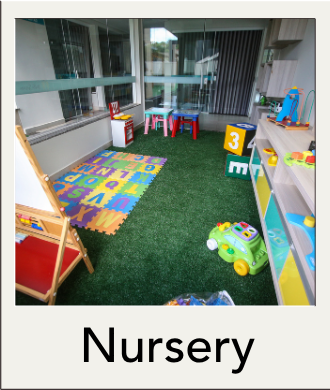
As each activity is completed, the child can:
- Remove the picture
- Turn it over
- Place it in a finished box
- Tick it off
This helps children see:
- What they have already done
- What is happening now
- What is coming next
Research suggests that visual schedules can reduce anxiety during transitions and increase participation in everyday activities (Knight et al., 2015).
Using Now-and-Next Boards
Now-and-next boards provide a very simple visual representation of what is happening currently and what will happen afterwards.
For many preschool children, a full day’s schedule may feel overwhelming. A now-and-next board focuses only on the immediate future.
For example:
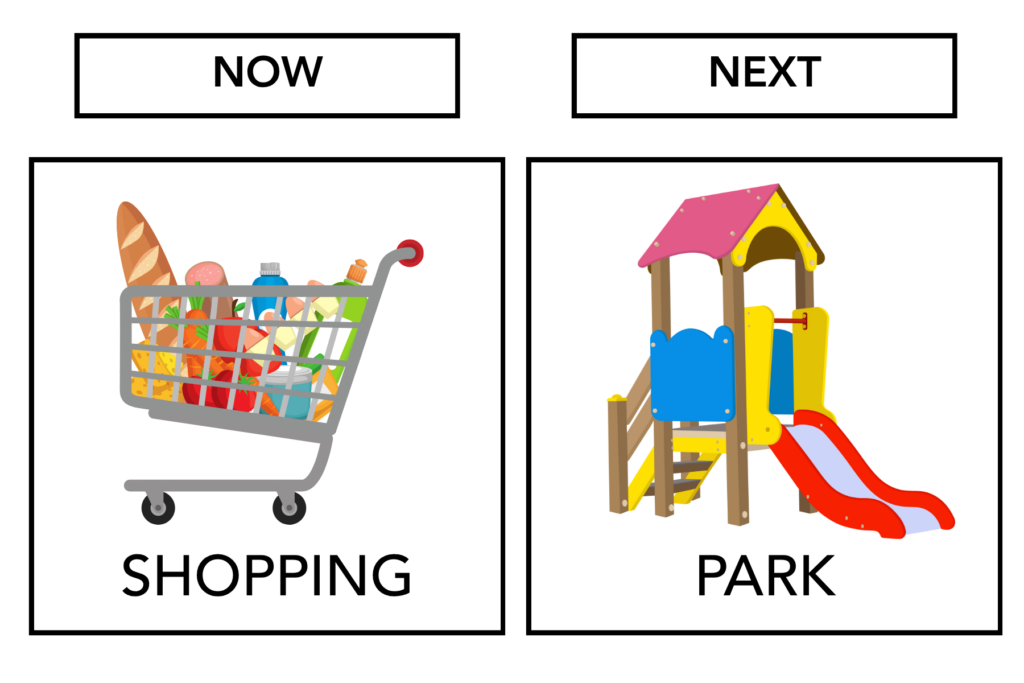
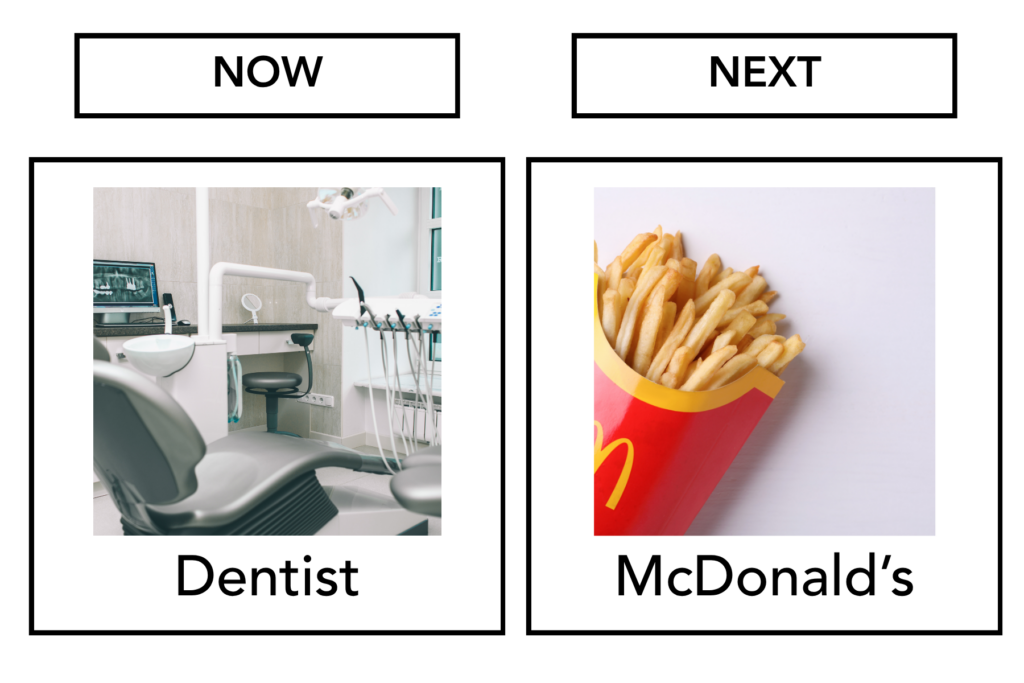
This can be particularly helpful when introducing less preferred activities.
For example:
Supporting Independence Through Visual Instructions
One of the greatest benefits of visual supports is their ability to promote independence.
Many daily living skills involve multiple steps. Autistic children may understand each individual step but struggle to remember the sequence.
Visual instructions break tasks into manageable stages.
Teaching Dressing Skills
A dressing sequence might show:
- Underwear
- Trousers
- T-shirt
- Socks
- Jumper
- Coat
Photographs of the child’s own clothes often work best initially.
The child can check each picture while completing the task.
This reduces the need for repeated verbal prompts such as:
- “What’s next?”
- “Put your socks on.”
- “Don’t forget your jumper.”
Over time, children often begin using the visual guide independently.
Teaching Handwashing
A handwashing visual sequence might include:
- Turn on tap
- Wet hands
- Apply soap
- Rub hands
- Rinse
- Turn off tap
- Dry hands
Visual supports can improve consistency and independence while helping children develop hygiene skills.
Using Visual Supports to Develop Safety Awareness
Many parents worry about their child’s understanding of danger.
Research suggests that some autistic children may have difficulty recognising risk due to differences in social understanding, sensory processing, impulsivity, attention or danger awareness.
Visual supports can play an important role in teaching safety concepts.
It is important to recognise that learning safety skills often requires repeated teaching and practice.
Teaching “Stop” Signs
Simple visual stop signs can be used consistently across environments.
For example:
- On external doors
- Near roads
- At driveways
- Near hazards
The goal is for the child to learn:
Red stop sign = stop your body.
This can initially be practised during games before being generalised to real-life situations.
Using Visual Safety Symbols
Pictures can help children learn common dangers such as:
- Hot surfaces
- Roads
- Water hazards
- Dogs
- Electrical outlets
- Medicines
- Sharp objects
For preschool children, photographs are often easier to understand than abstract warning signs.
For example:
A photograph of the family’s cooker with a visual symbol indicating “hot” may be easier to understand than a generic warning symbol.
Visual rules are often easier to recall during times of stress.
Road Safety Supports
Visual teaching can help children understand the steps involved in crossing roads safely.
A visual sequence might show:
- Stop
- Hold hands
- Look left
- Look right
- Listen
- Cross
Repeated use of the same visual sequence helps reinforce learning over time.
Tips for Choosing Effective Visual Supports
Visual supports work best when they are:
Individualised
Use pictures that are meaningful to the child where possible.
Often this means:
- Real photographs
- Familiar objects
- Familiar places
rather than generic symbols
Consistent
Use the same visuals repeatedly.
Changing symbols frequently can make learning more difficult.
Accessible
Visuals should be placed where they are needed.
For example:
- Dressing chart in the bedroom
- Handwashing chart in the bathroom
- Daily planner in the kitchen
Positive
Focus on what the child should do rather than what they should not do.
For example: Teach: “Hold hands”, rather than: “Don’t run away”
Final Thoughts
Visual supports are a simple but highly effective way to help autistic preschool children understand their world. They can reduce anxiety, improve communication, increase independence and support the development of everyday skills. Whether using a visual daily planner, a now-and-next board, step-by-step dressing instructions or visual safety reminders, these tools help make expectations clearer and more predictable.
Perhaps most importantly, visual supports allow children to rely less on adult prompting and more on their own understanding. Over time, this can build confidence, competence and independence. For many autistic children, visual supports are not simply an educational tool—they are a bridge to greater participation, autonomy and success in everyday life.
References
Hodgdon, L.Q. (1995) Visual Strategies for Improving Communication: Practical Supports for School and Home. Troy, MI: QuirkRoberts Publishing.
Hume, K., Steinbrenner, J.R., Odom, S.L., Morin, K.L., Nowell, S.W., Tomaszewski, B., Szendrey, S., McIntyre, N.S., Yucesoy-Ozkan, S. and Savage, M.N. (2021) ‘Evidence-based practices for children, youth and young adults with autism: Third generation review’, Journal of Autism and Developmental Disorders, 51(11), pp. 4013–4032.
Knight, V., Sartini, E. and Spriggs, A.D. (2015) ‘Evaluating visual activity schedules as evidence-based practice for individuals with autism spectrum disorders’, Journal of Autism and Developmental Disorders, 45(1), pp. 157–178.
Mesibov, G.B., Shea, V. and Schopler, E. (2005) The TEACCH Approach to Autism Spectrum Disorders. New York: Springer.
Wong, C., Odom, S.L., Hume, K.A., Cox, A.W., Fettig, A., Kucharczyk, S., Brock, M.E., Plavnick, J.B., Fleury, V.P. and Schultz, T.R. (2015) ‘Evidence-based practices for children, youth and young adults with autism spectrum disorder: A comprehensive review’, Journal of Autism and Developmental Disorders, 45(7), pp. 1951–1966.