Introduction
One of the earliest building blocks of communication and social development is a skill known as joint attention. Long before children begin having conversations, they learn to share experiences with other people by looking, pointing, showing and following another person’s gaze. These simple interactions help children learn language, understand social relationships and develop an awareness that other people have their own thoughts, feelings and interests.
Joint attention develops naturally in most children during the first two years of life and is considered one of the most important pre-language skills. Research has consistently shown that joint attention plays a crucial role in language development, social understanding and later learning. Difficulties with joint attention are also one of the earliest and most well-established signs associated with autism.
Understanding joint attention can help parents recognise early developmental differences and identify practical ways to support their child’s communication and social development.
What Is Joint Attention?
Joint attention refers to the ability to share attention with another person towards an object, activity or event.
It involves three things:
- The child
- Another person
- Something that both people are paying attention to
For example:
- Your child sees an aeroplane and points to it, then looks back at you to check whether you are looking too.
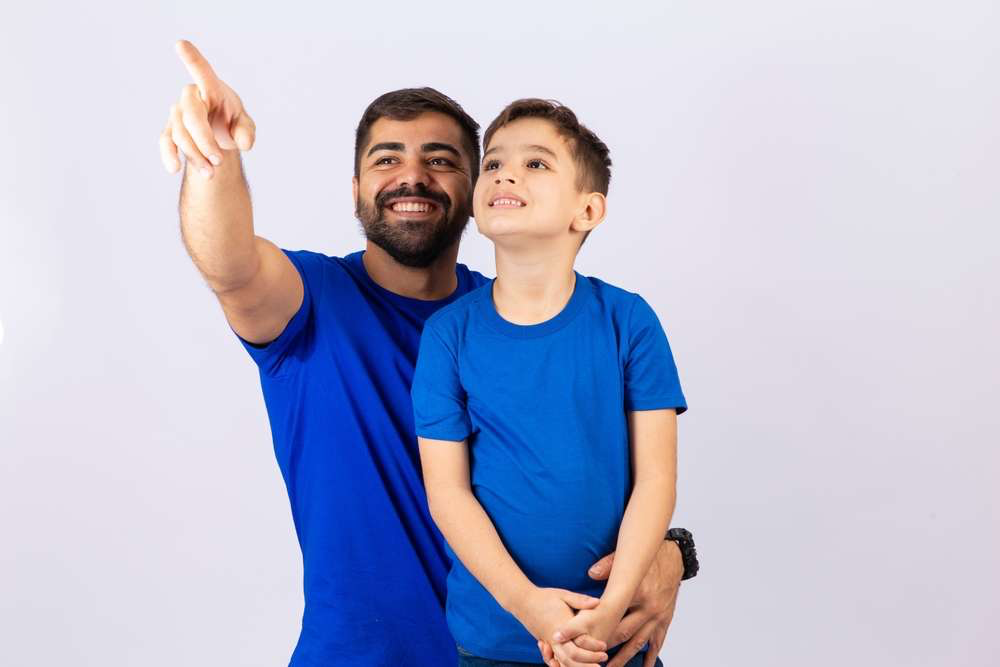
- You point to a dog in the park and your child follows your point to look at the dog.
- You and your child look at a picture book together and comment on the pictures.
Joint attention is not simply looking at the same thing as someone else. It involves an awareness that another person is sharing the experience.
Why Is Joint Attention Important?
Joint attention forms the foundation for many aspects of development.
Research has shown that it supports:
Language Development:
Children learn language by connecting words with objects, actions and experiences. Joint attention creates opportunities for this learning.
For example:
- Parent points to a bird.
- Child looks at the bird.
- Parent says, “Look at the bird.”
Repeated experiences like this help children connect words and meanings.
Social Development:
Joint attention teaches children that experiences can be shared with other people.
It helps children learn:
- Turn-taking
- Social reciprocity
- Social relationships
- Emotional understanding
Learning and Cognitive Development:
Young children learn a huge amount by observing other people and sharing attention.
Joint attention helps children:
- Follow instructions
- Engage with learning activities
- Understand other people’s intentions
- Develop symbolic and imaginative play
Research consistently demonstrates strong relationships between joint attention skills and later language, social and academic outcomes.
When Does Joint Attention Typically Develop?
Joint attention develops gradually during infancy.
Research suggests the following pattern:
Around 6–9 Months:
Babies begin:
- Looking where adults look
- Following gaze
- Showing interest in faces
- Sharing attention during interactions
Around 9–12 Months:
Babies start:
- Following pointing gestures
- Looking back and forth between objects and people
- Showing objects to caregivers
- Responding when adults direct attention
Around 12–18 Months:
Children begin:
- Pointing to share interest
- Initiating joint attention independently
- Looking to adults for shared enjoyment
- Coordinating eye contact, gestures and vocalisations
By the second year of life, most children are regularly using joint attention during everyday activities.
What Is the Link Between Joint Attention and Autism?
Joint attention difficulties are among the earliest and most widely studied characteristics associated with autism.
Research suggests that many autistic children:
- Initiate joint attention less frequently
- Respond less consistently to another person’s attempts to share attention
- Show fewer pointing behaviours
- Use less eye gaze to share experiences
- Focus more on objects than social interactions
Importantly, this does not mean autistic children are uninterested in other people. Rather, the development of social attention and communication may occur differently.
Research has found that differences in joint attention during infancy are associated with later autism risk and are considered one of the earliest markers of autism.
Joint attention is therefore routinely observed during autism assessments for young children.
Signs That a Child May Not Have Developed Joint Attention Skills
Children develop at different rates, and a single behaviour should never be used in isolation to determine whether a child is autistic.
However, signs that may indicate difficulties with joint attention include:
Limited Response to Pointing:
The child rarely:
- Looks where others point
- Follows another person’s gaze
- Notices what someone else is trying to show them
Reduced Pointing:
The child may:
- Point to request something they want
- But rarely point simply to show interest or share enjoyment
For example, they may point to a biscuit they want but not point to an aeroplane in the sky to show you.
Rarely Bringing Things to Show Others:
Many children enjoy bringing objects to share with adults.
Children who struggle with joint attention may:
- Play independently with objects
- Rarely bring items to show a parent
- Show less interest in sharing experiences
Limited Back-and-Forth Eye Contact:
You may notice that your child:
- Focuses strongly on objects
- Makes less frequent gaze shifts between people and objects
- Does not check whether others are looking at the same thing
Reduced Social Referencing:
Typically developing children often look at trusted adults to help them understand unfamiliar situations.
Children with difficulties in joint attention may do this less frequently.
Preference for Independent Play:
Some children appear highly focused on objects or activities and may show less interest in involving others in what they are doing.
How Can Parents Support Joint Attention Development?
A neurodiversity-affirming approach recognises that autistic children communicate differently and that support should focus on creating meaningful opportunities for connection rather than forcing eye contact or changing autistic behaviours.
The goal is to build shared engagement in ways that are enjoyable for the child.
Follow Your Child’s Interests:
Research suggests that motivation is important when developing joint attention skills.
Instead of directing your child towards activities you choose:
- Observe what interests them
- Join in with that activity
- Become part of their play
For example:
If your child loves trains, sit alongside them and engage with their train play rather than trying to redirect them to something else.
Get Face-to-Face:
Position yourself so your child can easily see your face.
This might mean:
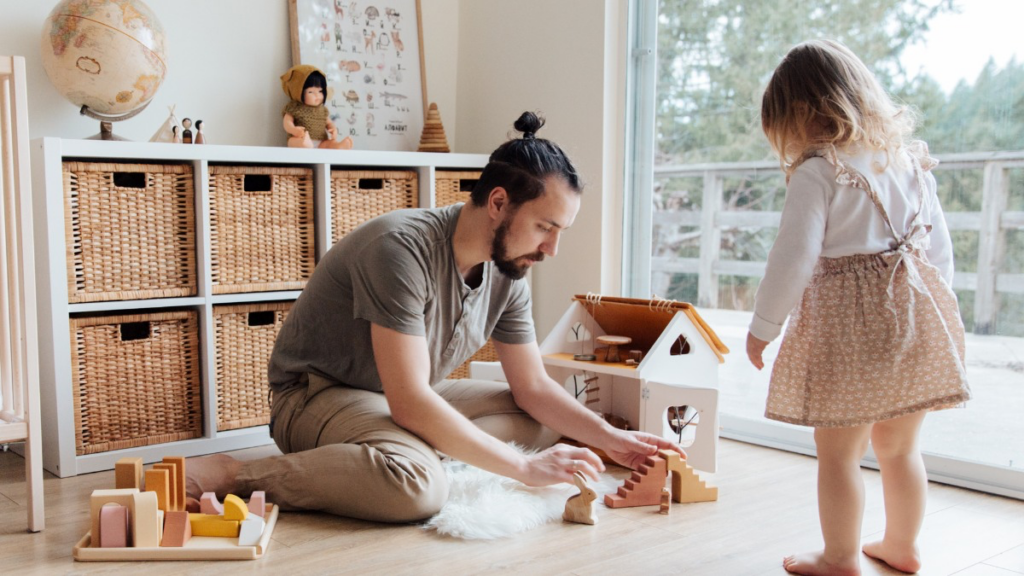
- Sitting on the floor
- Playing opposite them
- Using interesting facial expressions
The aim is not to demand eye contact but to make social interaction enjoyable and accessible.
Use Animated Communication:
Children are often more likely to notice communication when adults use:
- Excited voices
- Facial expressions
- Gestures
- Pauses
- Anticipation
For example:
“Ready… steady… GO!”
during a favourite game can encourage shared attention naturally.
Play Turn-Taking Games:
Simple games help build social engagement:
- Rolling a ball
- Peek-a-boo
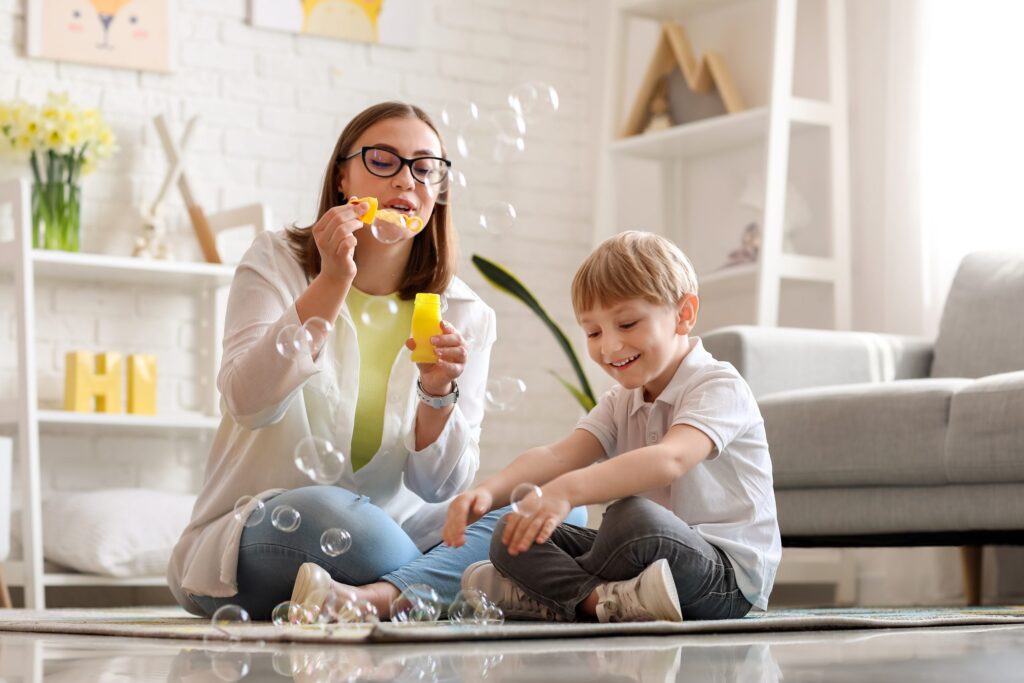
- Bubbles
- Ready-steady-go games
- Tickling games (if enjoyed)
These activities encourage children to pay attention to another person’s actions and responses.
Use Highly Motivating Activities:
Joint attention often develops best when activities are enjoyable.
Examples include:
- Bubbles
- Wind-up toys
- Balloons
- Musical toys
- Favourite sensory activities
Pause during the activity and wait to see whether your child looks at you, vocalises or indicates they want more.
Comment Rather Than Question:
Many adults ask lots of questions.
Instead, try commenting:
“Wow, that’s a big train!”
“The bubbles are floating!”
This reduces pressure and creates natural opportunities for shared attention.
Respond to All Communication Attempts:
If your child:
- Looks at you
- Vocalises
- Gestures
- Brings you an object
- Respond positively.
This teaches them that sharing experiences with others is rewarding.
Consider Professional Support
If you are concerned about your child’s communication or social development, support may be available from:
- Speech and Language Therapists
- Early Years Services
- Community Paediatricians
- Autism assessment services
Interventions that focus on shared engagement and parent-child interaction have been shown to support early social communication development.
Final Thoughts
Joint attention is one of the earliest and most important social communication skills to develop during childhood. It forms the foundation for language learning, social understanding and later communication skills. Most children begin developing joint attention during the first year of life and continue refining these skills throughout toddlerhood.
Difficulties with joint attention are one of the earliest recognised characteristics associated with autism, but they do not automatically mean a child is autistic. Rather, they are an important indicator that a child’s social communication development may be progressing differently.
Supporting joint attention is not about teaching children to behave more like their peers. Instead, it is about creating meaningful opportunities for shared experiences, connection and communication. By following a child’s interests, engaging in enjoyable activities and responding warmly to communication attempts, parents can help lay the foundations for future language and social development.
References
Butterworth, G. and Jarrett, N. (1991) ‘What minds have in common is space: Spatial mechanisms serving joint visual attention in infancy’, British Journal of Developmental Psychology, 9(1), pp. 55–72.
Charman, T. (2003) ‘Why is joint attention a pivotal skill in autism?’, Philosophical Transactions of the Royal Society B: Biological Sciences, 358(1430), pp. 315–324.
Mundy, P. and Jarrold, W. (2010) ‘Infant joint attention, neural networks and social cognition’, Neural Networks, 23(8–9), pp. 985–997.
Montagut-Asunción, M., Crespo-Martín, S., Pastor-Cerezuela, G. and D’Ocon-Giménez, A. (2022) ‘Joint Attention and Its Relationship with Autism Risk Markers at 18 Months of Age’, Children, 9(4), 556.
Mundy, P. and Newell, L. (2007) ‘Attention, joint attention and social cognition’, Current Directions in Psychological Science, 16(5), pp. 269–274.
Tomasello, M. (1995) Joint Attention as Social Cognition. In: Moore, C. and Dunham, P.J. (eds.) Joint Attention: Its Origins and Role in Development. Hillsdale, NJ: Lawrence Erlbaum Associates, pp. 103–130.
Zwaigenbaum, L., Bauman, M.L., Stone, W.L., Yirmiya, N., Estes, A., Hansen, R.L., McPartland, J.C., Natowicz, M.R., Choueiri, R. and Fein, D. (2015) ‘Early identification of autism spectrum disorder: Recommendations for practice and research’, Pediatrics, 136(Suppl 1), pp. S10–S40